

- CAF cavitation air flotation is easy to install and maintain.
- How does our CAF flotation equipment work?
- Main components of the CAF float
- Main applications of our CAF float
- Results obtained with our CAF flotation system
- Key advantages of our CAF flotation system
1. CAF cavitation air flotation is easy to install and maintain.
Our CAF flotation equipment – with Hydrocal®‘s patented aeration system – removes suspended solids, grease and colloids from the water being treated. Their compact and functional design makes our CAF floats easy to install, operate and maintain with low operating costs.
Unlike the operation of our DAF dissolved air DAF dissolved air flotationour cavitation air flotation system is based on the injection of microbubbles directly into the wastewater flow, without prior air supply.
It is a flotation equipment that does not require air compressors, pumps or pressure tanks for the proper treatment of wastewater.
Its rectangular and compact design facilitates its installation in small spaces. The CAF flotation equipment is composed of the following four sections:
1# Aeration section by means of a cavitation diffuser.
2# Flotation (clarification) section.
3# Solids discharge chute by worm screw.
4# Clarified water discharge channel through adjustable overflow.

The 4 sections of the flotation equipment CAF
How does our CAF flotation equipment work?
1# Aeration section
In the first aeration section, the aerator draws in ambient air, which descends through the aerator’s central shaft and is introduced in the form of microbubbles directly into the wastewater flow. During their ascent, the microbubbles adhere to the solids in suspension dragging them to the surface where they remain in a floating state.

At this point, the rake-blades sweep the floating solids, greases, oils, suspensions and colloids, driven by a set of chains, and convey them to the discharge channel. Once there, the auger collects and transports the solids to a sludge container.
The water from the flotation section is continuously recycled in the aeration chamber through recirculation pipes, thus preventing the formation of sediment. Also, the continuous circulation of water in the aeration chamber is fully guaranteed, even if the power supply to the equipment is interrupted.
The clarified water flows into an adjustable overflow to control the level of the main tank and finally, it is directed directly from the overflow to the discharge.
3. Main components of the CAF float
1# The float sweep mechanism
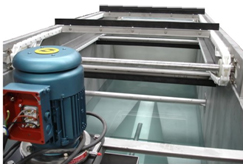 At the top of the unit is a float sweeping mechanism, extended over the entire surface area and electrically operated. Its polyacetal chain drive is low friction and very robust, with neoprene blades and AISI 304/316 stainless steel supports and IP55 protection. The speed of this mechanism is variable by frequency inverter.
2# The floating sludge screw conveyor
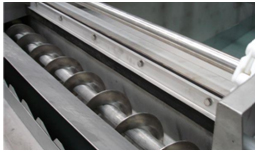 The paddles pick up the floating sludge and drag it to a screw conveyor that transports it out of the equipment. The auger is made of stainless steel and is a fully automated operating system.
The sludge screw conveyor can be manufactured with flat or conical bottom.
3# Aerator
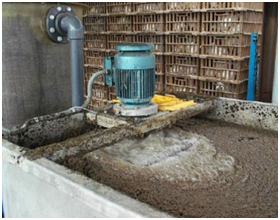 The aerator is the most important component of any CAF equipment since it is in charge of producing the micro bubbles that will float the solids and fats that will be eliminated by flotation.
The correct operation of this element will allow us to achieve high water elimination yields.
In our equipment we install the aerator of the American firm Hydrocal® of robust and high quality manufacture. We have been able to prove it in all the CAF flotation equipment that we have implemented for more than 20 years, providing our customers with a adequate and efficient wastewater and efficient wastewater treatment.
4. Main applications of our CAF float
Below, we have compiled the main applications of our CAF cavitation air flotation system and the sectors with the highest demand for this equipment.
CAF technology is applied as primary treatment in the following sectors:
– Food processing plants
– Slaughterhouses
– Meat and canning industries.
– Lipid production plants
– Dairy industries
– Citrus processing
– Cosmetic industries
– Municipal wastewater treatment plants
– Paper industries
– Tanneries
– Oil installations
– Chemical processing plants
It is also used as a secondary decanter in biological processes:
– For physico-chemical and/or biological sludge thickening
5. Results obtained with our CAF flotation system.
“Our flotation flotation equipment provide highly efficient water clarification”
– The CAF system is very efficient in the separation of suspended and colloidal solids, as well as in the removal of oils and greases.
– In general terms, using the appropriate reagent dosage, the efficiency in the Separation of Suspended Solids (SS or MES), Oils and Fats (A and G) exceeds more than 90% in general; and depending on the application, it can reach 99%.
– The reduction of the Biological Oxygen Demand (BOD 5) value depends on the organic content and its biodegradability in the separated solids, for each particular case, although, in general, an average reduction of 40-70% is achieved with the CAF float.
– The percentages of Chemical Oxygen Demand (COD) reduction are generally a little higher than the previous ones, since biodegradability is not included, being therefore possible to exceed 70% with the CAF system, especially when the concentration of suspended solids is high.
– Typical reduction percentages obtained with the CAF system:
| MES – separation of suspended solids | 90-95% |
| A and G – oils and fats | 95-99% |
| COD – chemical oxygen demand | 45-55% |
| BOD – biological oxygen demand | 40-45% |
6. The key advantages of our CAF flotation system are as follows
– It is easy to install, easy to operate and quick to start up.
– Compact rectangular design in AISI 304 or AIS 316
– Easy access to all moving parts
– Low power consumption 1-2 hp
– High capacity from 3 to 200 m3/h
– No underground piping installation required
– Compact, rectangular design facilitates flexible installation
– Minimal maintenance time; no cleaning of nozzles or nozzles is required.
– No air compressors, pumps or pressure tanks are required.
– They are tailor-made flotation equipment.
“Our CAF flotation equipment is compact, easy to install, operate and maintain at a low operating cost.”
Contact our experts to learn more about our CAF float or to offer you a technical advice service more suited to your specific needs.